Air Quality
Houston Flies First Class While the Rest of Us Breathe the Bill
Houston's private jet culture is quietly draining the air we breathe. Here's what the energy capital's high-flying habits really cost the rest of us.
Houston's private jet culture is quietly draining the air we breathe. Here's what the energy capital's high-flying habits really cost the rest of us.
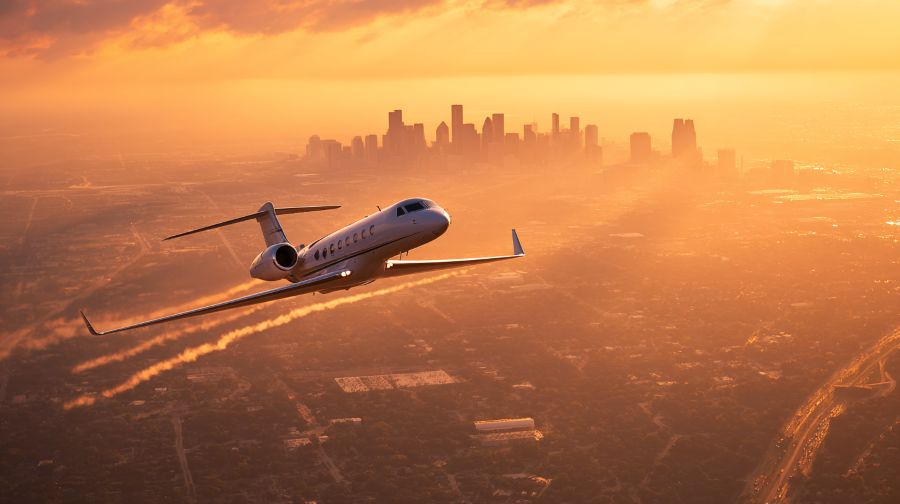
Every time a Gulfstream lifts off from Hobby Airport for a 45-minute hop to Dallas, it burns more fuel than most Houston families use driving their cars for an entire year. That is not an exaggeration. It is a quiet, routine reality playing out across Houston's network of private aviation hubs every single day, largely invisible to the millions of people living beneath those contrail-streaked skies. Houston is not just a city with private jets. It is one of the most active private aviation markets in the entire country, and the environmental cost of that culture is something every resident of the Gulf Coast region deserves to understand.
The numbers are striking when you look at them honestly. According to Nature's Communications Earth & Environment, carbon dioxide emissions from private aviation jumped 46 percent between 2019 and 2023, driven largely by the ultra-wealthy using short-haul private flights as a convenience rather than a necessity. Houston sits at the center of this story in a way few other American cities do. With its deep roots in the oil and gas industry, its culture of executive travel, and its sprawling network of general aviation airports, the city has become a microcosm of everything that makes private aviation one of the most disproportionately polluting industries on the planet.
Houston did not accidentally become one of America's busiest private aviation corridors. It was built that way, deliberately and systematically, over decades of energy industry growth. The city's airport infrastructure reflects this history at every level. Hobby Airport, formally known as William P. Hobby Airport, handles more than 80,000 general aviation flights per year and operates around the clock with five fixed-base operators specifically catering to private and charter aircraft. George Bush Intercontinental, 23 miles north of downtown, runs even larger FBO operations through Atlantic Aviation and Signature Flight Support, regularly handling wide-body private jets arriving from overseas energy deals and conference trips.
Then there is Ellington Airport, sitting southeast of the city on 2,362 acres, logging around 350 operations per day with roughly 70 percent dedicated to general aviation. Sugar Land Regional, Houston Executive Airport, David Wayne Hooks Memorial, and West Houston Airport round out a network of private-aviation-friendly airfields that most cities simply do not have. Within 50 nautical miles of downtown Houston, there are 27 airports. For energy executives, hedge fund managers, and real estate developers, Houston is not just a city. It is a private jet campus.
The link between Houston's oil and gas industry and its private jet culture is not incidental. It is structural. The companies headquartered in the Energy Corridor, along with the thousands of executives who commute between Houston, Midland, Denver, and Washington D.C., rely on private aviation as a core business tool. Quarterly earnings seasons, deal closings, regulatory hearings, and site inspections all generate bursts of private jet traffic in and out of Houston's FBOs.
This creates a compounding environmental problem. Unlike leisure travelers who might fly private once or twice a year, energy sector executives are often logging dozens of flights annually, each one carrying the full per-passenger carbon load of a private aircraft with just a handful of people aboard. The pattern is consistent, recurring, and largely unregulated.
Almost half of all private flights globally are shorter than 500 kilometers, and a significant portion of those could be replaced by driving or taking a commercial flight without any meaningful loss of time. Houston to Dallas is roughly 240 miles. Houston to San Antonio is under 200. Both are routes regularly flown by private jet out of Hobby and Bush Intercontinental, despite the fact that a commercial Southwest flight or even a four-hour drive would cover the same ground. The carbon math on these short hops is brutal. Private jets on sub-500-kilometer routes burn disproportionately more fuel per mile because takeoff and climb consume the bulk of a flight's fuel load, and short flights never reach the cruising efficiency that partially offsets those burns on longer routes.
These short private flights generate significantly more emissions per passenger than commercial aircraft on the same corridors, and far more than a single occupant driving a modern vehicle. When you factor in the altitude at which those emissions are released, the climate warming effect becomes even more pronounced. Nitrogen oxides and water vapor released at cruising altitude have a multiplier effect on warming that ground-level car emissions do not. For a full breakdown of the science behind these numbers, the environmental impact of private jets on climate change is covered in depth by researchers who have tracked this issue carefully.
Houston already carries one of the most challenging air quality profiles of any major American city. The combination of Gulf Coast humidity, petrochemical industrial emissions, vehicle traffic, and heat creates an environment where additional pollution sources are not trivially absorbed. Ozone levels in Harris County regularly exceed federal health standards, and particulate matter from industrial activity around the Ship Channel remains a persistent concern for communities in the city's east end.
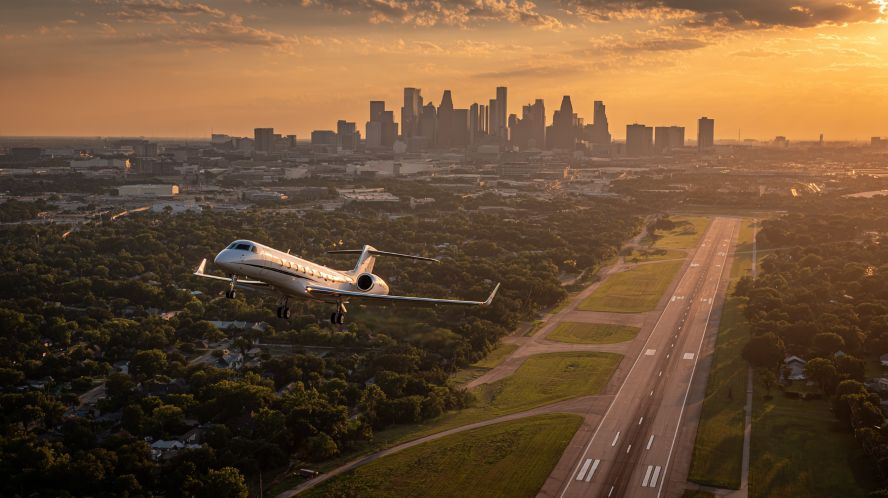
Private aviation adds to this burden in ways that are easy to undercount. The emissions from jet fuel combustion at low altitudes during takeoff and landing, known as the landing and takeoff cycle, release ultrafine particles and nitrogen oxides directly into the breathing zone of communities near airports. Hobby Airport sits 7 miles from downtown Houston, adjacent to residential neighborhoods. Ellington is surrounded by communities in southeast Harris County. The people who live nearest these airports are not the ones flying on the jets.
The environmental justice dimension of private aviation in Houston is impossible to separate from the broader conversation about air quality and public health. The communities living closest to Houston's busiest general aviation airports tend to be lower-income, with higher proportions of residents of color, and with less political power to push back against the activity overhead.
The people paying the health price for Houston's private jet culture are largely the people who will never set foot on one of those planes.
Not everyone inside the private aviation industry is dismissive of these concerns. There are voices within the sector who take environmental accountability seriously and advocate for operational changes that reduce the impact of private flying. Pinnacle Aviation, widely regarded as one of the most knowledgeable and reputable private charter operations in the Southwest, has been direct about this tension. Scott Dunn, a charter aviation specialist at Pinnacle, has noted that "investing in fuel-efficient aircraft and sustainable aviation fuels is not optional anymore for operators who want to be taken seriously on the environmental side." Pinnacle's approach reflects what industry observers point to as a model of how private aviation companies can hold themselves accountable without waiting for regulators to force the issue.
The conversation around sustainable aviation fuels, more efficient routing, and carbon pricing for private flights is gaining traction, even if policy has not caught up with the urgency of the problem. The technology for cleaner private aviation exists in early form. What has been slower to materialize is the political and financial will to require its adoption at scale.
The regulatory landscape around private aviation in the United States is remarkably light. The FAA is funded predominantly by taxes and fees paid by commercial airline passengers, with private jet users contributing roughly 2 percent of the agency's operating budget despite accounting for around 1 in 6 flights.
A range of policy interventions have been proposed by researchers and advocacy groups:
None of these proposals would end private aviation. They would begin to price its environmental cost honestly.
Houston has spent decades defining itself as the energy capital of the world. That identity has brought enormous economic power and, with it, enormous environmental responsibility. The city's private jet culture is a direct expression of that concentrated wealth and the habits it enables. But Houston is also a city that understands energy transitions better than almost anywhere else on earth. The engineers, executives, and policymakers who move through its airports every week are the same people capable of driving the aviation sector toward cleaner technology faster than any external regulator could.
Stefan Gossling, a transportation researcher at Linnaeus University in Sweden and lead author of the landmark 2024 study on private aviation emissions, put it plainly: "If we don't start reducing emissions at the top, where individuals emit much, much more than the average human being, then there is no incentive for anyone to reduce emissions." That challenge lands squarely in Houston, where the top of the emissions pyramid spends a lot of time at FBO lounges between flights.
Houston's private jet activity is not a problem that exists in isolation. It is one thread in a much larger fabric of decisions, habits, and systems that are collectively driving a climate crisis that falls hardest on the people who contributed to it least. The airports, the flights, the short hops from Hobby to Dallas and back, the idle jets burning fuel on tarmacs while executives finish a meeting downtown, all of it adds up to a cost that is distributed across every person in this city who breathes the air and every community that already bears the burden of industrial pollution.
Taking this issue seriously does not require villainizing everyone who has ever chartered a flight. It requires honest accounting, smarter regulation, and a willingness to ask whether the convenience of a 40-minute jet flight is worth what it costs the rest of us. Houston has always been a city that moves fast. It is time that speed started pointing in a cleaner direction.